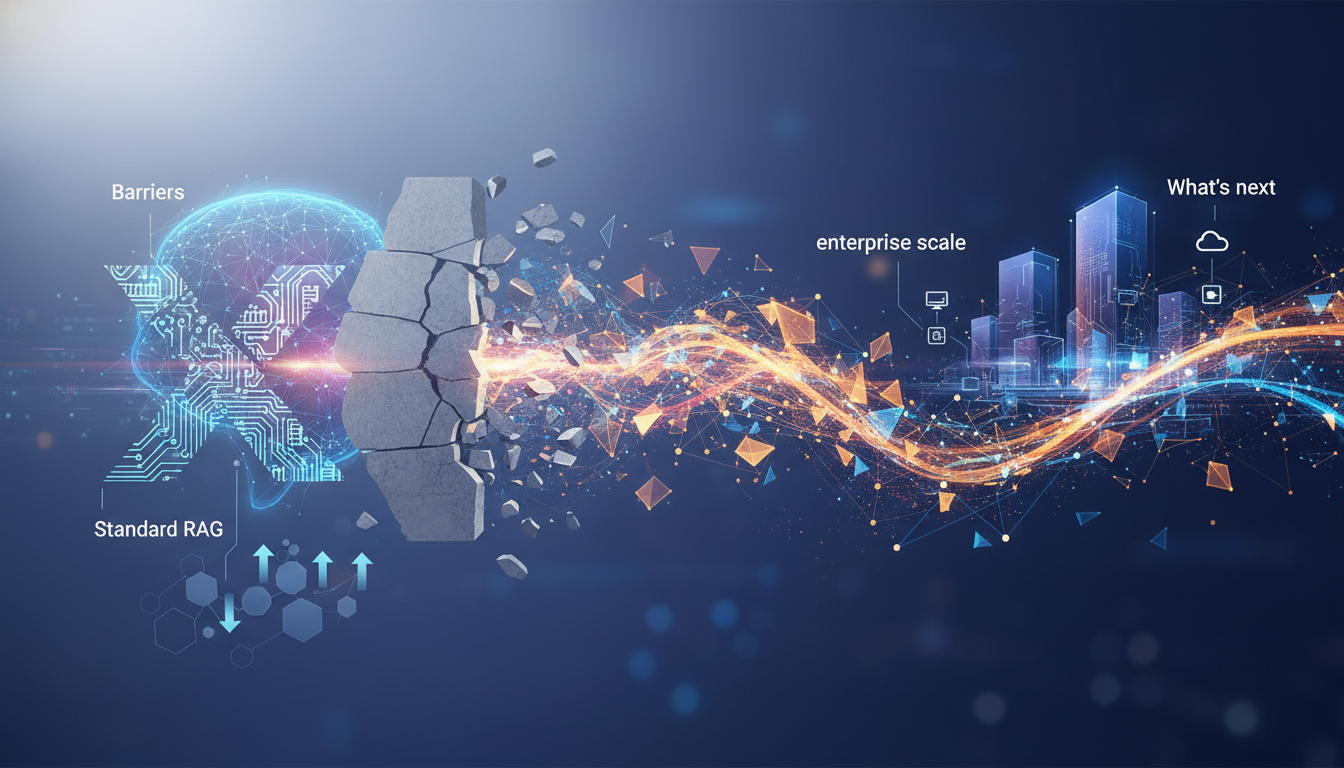
As enterprises increasingly adopt Retrieval-Augmented Generation (RAG) systems, many are discovering that what works in a controlled demo environment does not necessarily scale to production. A RAG system might function seamlessly with 10,000 documents, but falters at 1 million, and effectively collapses at 30 million. This is not merely a challenge of optimization; it's a fundamental architectural limitation.
The Pitfalls of Standard RAG Systems
One of the primary issues with Standard RAG systems at scale is the collapse of embedding spaces. These systems rely on vector similarity to extract relevant data chunks. While this is effective on a smaller scale, the vector space becomes too dense with millions of documents. Distinct concepts start to blur, leading to retrieval of contextually incorrect information. This phenomenon is a mathematical inevitability in high-dimensional vector spaces, not a flaw that can be corrected by modifying embedding models.
Another significant challenge lies in the chunking strategy. Standard RAG typically employs a fixed-size chunking method, which is inadequate for the diverse types of data enterprises deal with. Legal documents, for instance, require semantic chunking to preserve clause relationships, while technical documentation needs syntax-aware chunking. The one-size-fits-all approach of Standard RAG results in the fragmentation of critical context, leading to hallucinations and inaccurate responses when generating answers.
Enterprise queries often require multi-hop reasoning, where multiple related documents need to be synthesized to provide a comprehensive answer. Standard RAG's reliance on vector similarity for retrieval fails to establish or traverse these complex relationships, resulting in incomplete or irrelevant answers. This limitation is particularly frustrating for users who expect precise, actionable insights from their queries.
Some RAG systems attempt to manage complex queries through decomposition into sub-queries. However, this introduces inconsistency due to the probabilistic nature of language models. The same query can yield different sub-queries on different occasions, leading to varied and often contradictory answers. This inconsistency significantly undermines user trust and system reliability.
Standard RAG systems are inherently limited to static document retrieval and cannot integrate real-time data, which is vital for many enterprise decisions. As a result, they provide outdated information that fails to reflect current metrics or system states, leaving a critical gap in real-time decision-making capabilities.
Emerging Solutions to Standard RAG Limitations
Graph-Enhanced RAG systems are emerging as a powerful alternative, combining vector retrieval with knowledge graphs to map and traverse entity relationships. This architecture is particularly beneficial for industries like financial services, legal tech, and healthcare, where relational queries are common. The construction and maintenance of knowledge graphs are resource-intensive, but they offer significant accuracy improvements in multi-hop reasoning tasks.
Agentic RAG introduces a more dynamic approach by placing a language model within the retrieval loop. This allows for iterative planning, reasoning, and retrieval refinement, making it ideal for complex analytical tasks. While this approach may increase latency and cost, it significantly enhances accuracy by reducing hallucinations in multi-step reasoning tasks.
This approach tailors chunking strategies to the document type, preserving semantic coherence and structural context. By employing intelligent parsing, it dramatically improves retrieval precision across diverse document types, from technical specifications to legal contracts. Although more sophisticated parsing is required, the gains in precision are substantial.
Combining dense vector search with sparse keyword search and machine learning re-ranking, this method enhances precision, especially in large-scale repositories. While it involves greater infrastructure complexity, the improvement in retrieval precision, particularly for queries involving technical terminology, is notable.
To address the need for real-time data integration, Talk to Data Interfaces enable language models to generate and execute queries against live databases and APIs. This architecture allows enterprises to answer queries requiring both static document retrieval and real-time data computation, a capability that Standard RAG systems lack.
Conclusion: The Path Forward
The limitations of Standard RAG systems are becoming increasingly evident as enterprises scale their operations. The future of enterprise RAG lies not in tweaking existing systems but in adopting architectures that align with specific use case requirements. Whether it's Graph-Enhanced RAG for relational queries, Agentic RAG for analytical tasks, or hybrid approaches for precision and real-time integration, the evolution of RAG systems is essential for maintaining competitiveness and operational efficiency in a data-driven world.
By auditing current systems and strategically implementing advanced architectures, enterprises can overcome the inherent challenges of Standard RAG and unlock the full potential of their data assets.