
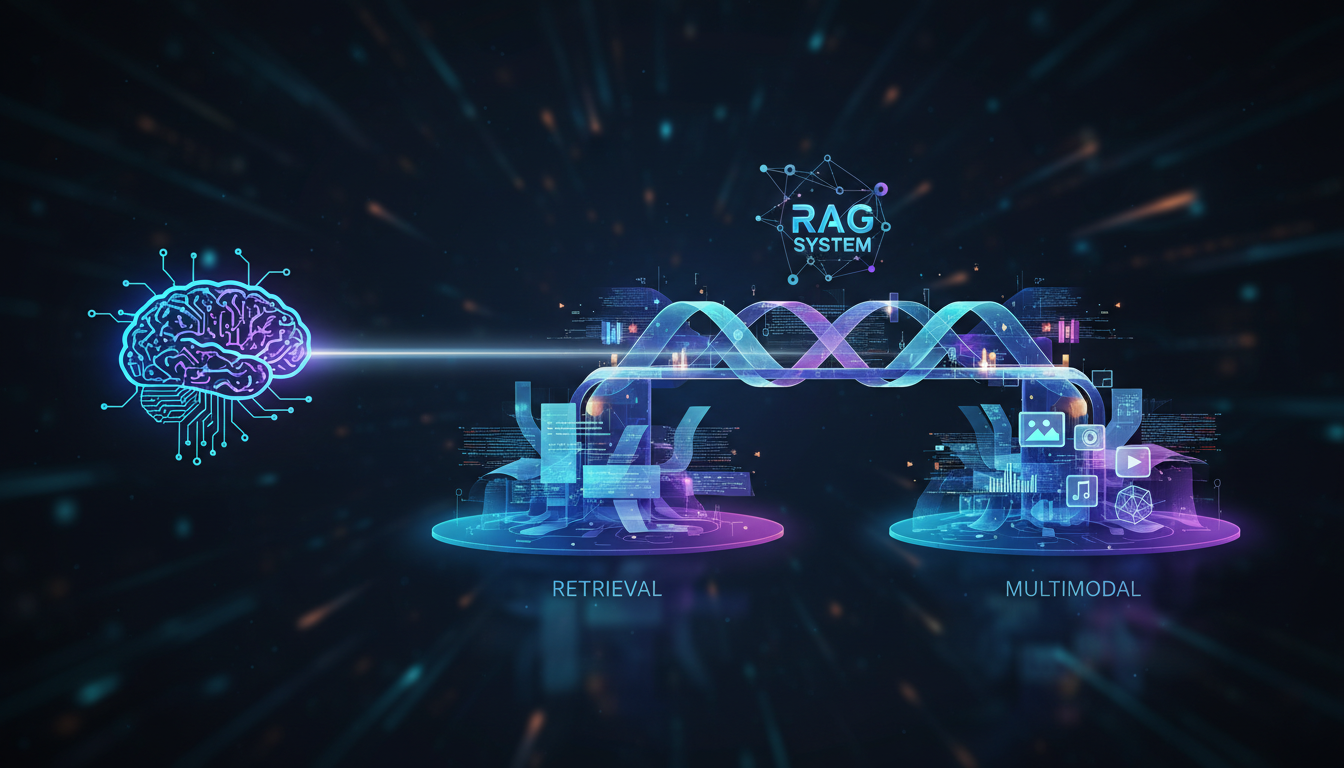
Enterprises today are flooded with vast amounts of data in different formats. Whether it's documents, images, audio, or video, the need for efficient retrieval systems has never been greater. Yet, many organizations rely on text-only Retrieval-Augmented Generation (RAG) systems, which fall short in the face of multimodal data. As we dive into the reasons and solutions for this gap, we’ll explore why your RAG system needs to embrace a multimodal approach.
Understanding the Limitations of Text-Only RAG Systems
Text-only RAG systems are adept at handling traditional documents. They can embed, index, and retrieve textual information with precision. However, they stumble when asked to process non-textual data, which makes up a significant portion of enterprise content. This includes diagrams, audio recordings, and videos—assets that hold valuable insights but remain untapped by text-centric systems.
The term "retrieval gap" aptly describes this scenario. While text-only systems can parse words from PDFs or Word documents, they ignore the visual and auditory information that might be crucial for comprehensive understanding. This is a fundamental architectural limitation that needs addressing in a world where data is predominantly unstructured and multimodal.
The Hidden Cost of Fragmented Systems
Companies often respond to the limitations of text-only RAG by developing separate systems for different data types. This leads to increased costs and maintenance burdens. Each system requires its own infrastructure, embedding model, and database, resulting in a fragmented approach that lacks the ability to reason across modalities.
This fragmentation creates format-specific blind spots. For example, a query about a technical process might retrieve the written documentation but miss out on associated diagrams or video walkthroughs. The inability to connect disparate pieces of information across formats leads to inefficiencies and missed opportunities.
Transitioning to a Multimodal Approach
To address these challenges, enterprises need to adopt a multimodal RAG system capable of processing and retrieving data across multiple formats in a unified manner. Here's how you can transition:
The simplest method involves converting non-textual data into text. Images get captioned, audio is transcribed, and videos are broken into frame captions. However, this reduces the richness of the original content and often results in loss of critical context and nuance.
A more sophisticated method involves maintaining distinct vector databases for each modality—text, images, and audio. This preserves the unique characteristics of each format but requires complex integration and coordination across systems.
The most advanced approach utilizes models that create unified embeddings across modalities, allowing for true semantic retrieval. This unified space enables a query to retrieve relevant information, whether it's text, images, or audio, ranked by semantic relevance.
Performance Considerations
While multimodal RAG systems offer richer retrieval capabilities, they introduce performance challenges. Processing images, audio, and video is computationally demanding, requiring robust infrastructure to handle large datasets without performance degradation. Pre-computing embeddings for stored content can mitigate real-time processing delays, but demands significant upfront processing.
When Text-Only Might Suffice
Despite the advantages of multimodal systems, text-only RAG systems remain suitable for scenarios where data is predominantly textual. Legal documents, contracts, and written specifications might not necessitate the complexity of multimodal retrieval. Evaluating your data composition and retrieval needs is crucial in determining the right approach.
The Path Forward: Incremental Adoption
For enterprises with existing text-only RAG systems, the transition to multimodal can be incremental. Begin by assessing your data to understand the proportion of non-text content. Identify high-value use cases that would benefit from multimodal retrieval and pilot additional modalities in your existing system. This phased approach minimizes risk while building expertise and validating the value of multimodal capabilities.
Conclusion: The Future of Enterprise RAG
The shift towards multimodal RAG systems is inevitable as enterprise data continues to diversify. By enabling format-agnostic retrieval, organizations can unlock insights trapped in non-textual data, enhance decision-making, and improve operational efficiency. The tools and platforms to facilitate this transition are available, and the time to evaluate and plan for a multimodal future is now.
Your enterprise's competitive edge may well depend on how quickly and effectively you bridge the retrieval gap with a multimodal RAG system.