
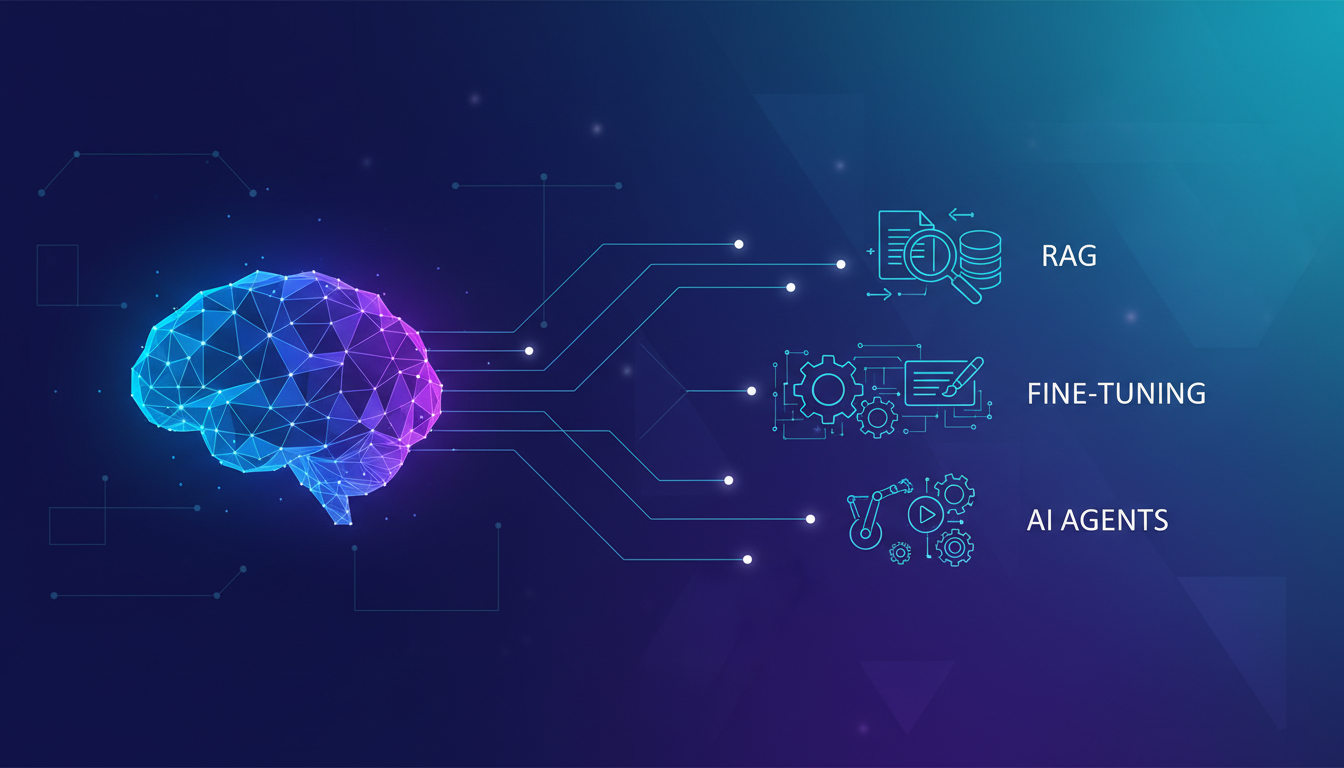
The rapid adoption of generative AI, powered by large language models (LLMs), has transformed enterprise operations. However, deploying LLMs effectively requires more than just enthusiasm. Enterprises must choose the right architectural strategy from options like Retrieval-Augmented Generation (RAG), fine-tuning, and AI agents.
Understanding RAG, Fine-Tuning, and AI Agents
RAG connects LLMs to external knowledge bases, enabling them to access real-time data during inference. This approach is crucial for enterprises needing immediate access to proprietary knowledge without retraining models. By embedding vector databases and retrieval layers, RAG provides dynamic information access, improving reliability and reducing erroneous outputs.
Strategic Benefits of RAG:
Use Cases : RAG is ideal for customer support automation, enterprise search, regulatory compliance, and healthcare decision support.
Fine-tuning involves training LLMs on specialized datasets to incorporate domain-specific expertise directly into model parameters. This approach is valuable for applications requiring deep domain understanding and specific communication styles.
Strategic Benefits of Fine-Tuning:
Challenges : Fine-tuning demands significant resources, including data preparation and computational power. It also requires retraining as domain knowledge evolves.
Use Cases : Suitable for legal analysis, financial reporting, and technical documentation.
AI agents represent a leap forward by automating entire workflows. Beyond mere information retrieval, they can plan, decide, and execute tasks autonomously, interacting with enterprise systems to complete processes.
Key Capabilities of AI Agents:
Use Cases : Ideal for IT operations, sales automation, claims processing, and finance operations.
Integrating RAG, Fine-Tuning, and AI Agents
While each approach offers unique advantages, enterprises often find that hybrid architectures deliver the best results. Combining these strategies allows organizations to leverage real-time data access, embedded expertise, and automated workflows.
Implementation Roadmap
Implementing enterprise AI requires a structured approach:
Conclusion
The choice between RAG, fine-tuning, and AI agents is not mutually exclusive. Enterprises that successfully integrate these approaches create robust AI platforms that improve decision-making, efficiency, and innovation. As AI continues to evolve, these hybrid strategies will be essential for maintaining a competitive edge. Organizations that invest strategically in these architectures will unlock the full potential of intelligent automation and data-driven insights.