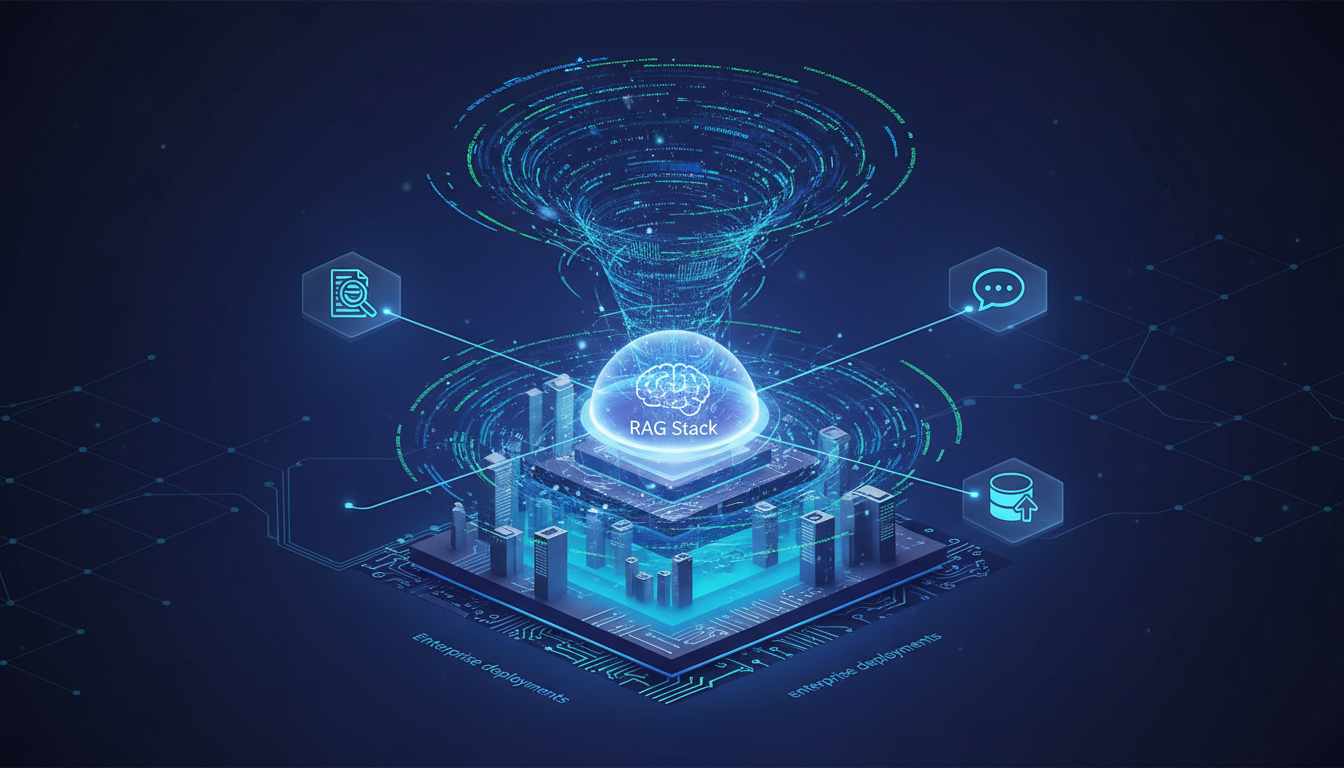
As enterprises increasingly adopt AI technologies, the Retrieval-Augmented Generation (RAG) framework has gained significant attention. However, the journey from concept to production can be fraught with challenges. These issues often stem not from the frameworks themselves but from the complexities of scaling, governance, and maintaining accuracy in dynamic environments. Let's delve into the components of the RAG stack and how they can be harnessed to create robust AI systems capable of handling real-world demands.
The Enterprise RAG Tool Landscape
The transition from experimental RAG frameworks to production-ready systems has not been without its hurdles. Industry analysis indicates that nearly 40% of enterprise RAG deployments falter post-proof-of-concept. The common culprits include degradation of retrieval accuracy under load, rising infrastructure costs, and difficulties in maintaining data governance. These issues highlight the need for a more integrated and layered approach to RAG deployment, moving beyond singular frameworks to a composite stack addressing specific weaknesses.
Why Most RAG Tools Fall Short in Production
Enterprise environments expose intrinsic limitations in standalone RAG frameworks. A recent survey revealed that 68% of AI teams experienced "context collapse," where retrieval quality deteriorates as the document corpus expands. Additionally, 52% reported governance issues, with RAG systems accessing sensitive data without proper oversight. These challenges underscore the necessity for a holistic approach that incorporates data preparation, retrieval optimization, response validation, and governance enforcement.
The Structured Query Engine: C3 AI’s Enterprise Approach
C3 AI's introduction of C3 Code marks a pivotal shift in enterprise RAG strategy by integrating structured business data with unstructured documents. This approach bridges the "structured data gap," crucial for handling text documents and structured databases containing vital business information. The integration layer of C3 Code translates natural language queries into both semantic searches and SQL queries, facilitating coherent responses that significantly reduce query resolution time.
The benefits of C3 Code have been profound:
The Specialized Vector Database: Pinecone’s Production-Ready Infrastructure
Pinecone has emerged as a preferred choice for enterprises requiring scalable and secure vector databases. The platform's architecture improvements specifically target RAG workloads, addressing scalability, security, and operational management. Pinecone's dynamic namespace isolation and real-time hybrid search capabilities enhance retrieval accuracy and operational reliability, especially during high-demand periods.
Pinecone's true value manifests during high-traffic incidents, ensuring consistent performance and operational reliability. Its ability to handle traffic spikes without degradation transforms RAG from experimental to business-critical, providing enterprises with the peace of mind that their systems can scale as needed.
The Open-Source Workhorse: LlamaIndex’s Framework Flexibility
For organizations prioritizing customization and control, LlamaIndex offers a flexible framework without vendor lock-in. Its focus on "data agents" allows for intelligent retrieval systems that understand and interact with enterprise data structures. This capability is essential for industries where document relationships are as significant as content, such as legal and compliance sectors.
LlamaIndex provides teams with the transparency needed to inspect and fine-tune every layer of their RAG pipeline. This control, while complex, is invaluable for organizations with unique requirements or stringent compliance needs, offering a level of flexibility that is often necessary in highly regulated industries.
The Integration Platform: LangChain’s Ecosystem Connectivity
LangChain addresses the integration challenge by providing a standardized method to connect RAG systems with existing enterprise tools. Its tool orchestration and memory management features streamline the handling of complex queries, enhancing deployment speed and reducing integration time from weeks to days.
LangChain's standardized connectors facilitate rapid integration, allowing organizations to focus on business logic rather than technical plumbing. This accelerates the time-to-value for RAG initiatives, enabling faster realization of benefits from AI deployments.
The Evaluation Suite: RAGAS’s Performance Measurement
RAGAS provides a framework for systematic evaluation of RAG systems, moving beyond anecdotal testing to automated metrics that assess answer relevance, context precision, and faithfulness. By establishing baseline metrics and continuous monitoring, enterprises can significantly reduce errors and enhance the reliability of their RAG systems.
Building Your Enterprise RAG Stack
Successful RAG deployments don't rely on a single tool but rather a strategic combination based on specific business needs. Key components include:
Strategic Selection Criteria
When building your RAG stack, consider factors such as data complexity, compliance requirements, performance SLAs, and team expertise. These criteria will guide the selection of tools that align with your enterprise's unique challenges and objectives.
The Path Forward
The journey to a successful RAG deployment begins with identifying critical business problems and mapping them to the capabilities of the RAG stack. By focusing on operational resilience rather than algorithmic sophistication, enterprises can build robust systems that not only meet but exceed their business requirements. The key is to start with the problem, not the technology, and build a stack that is agile, resilient, and tailored to your specific needs.