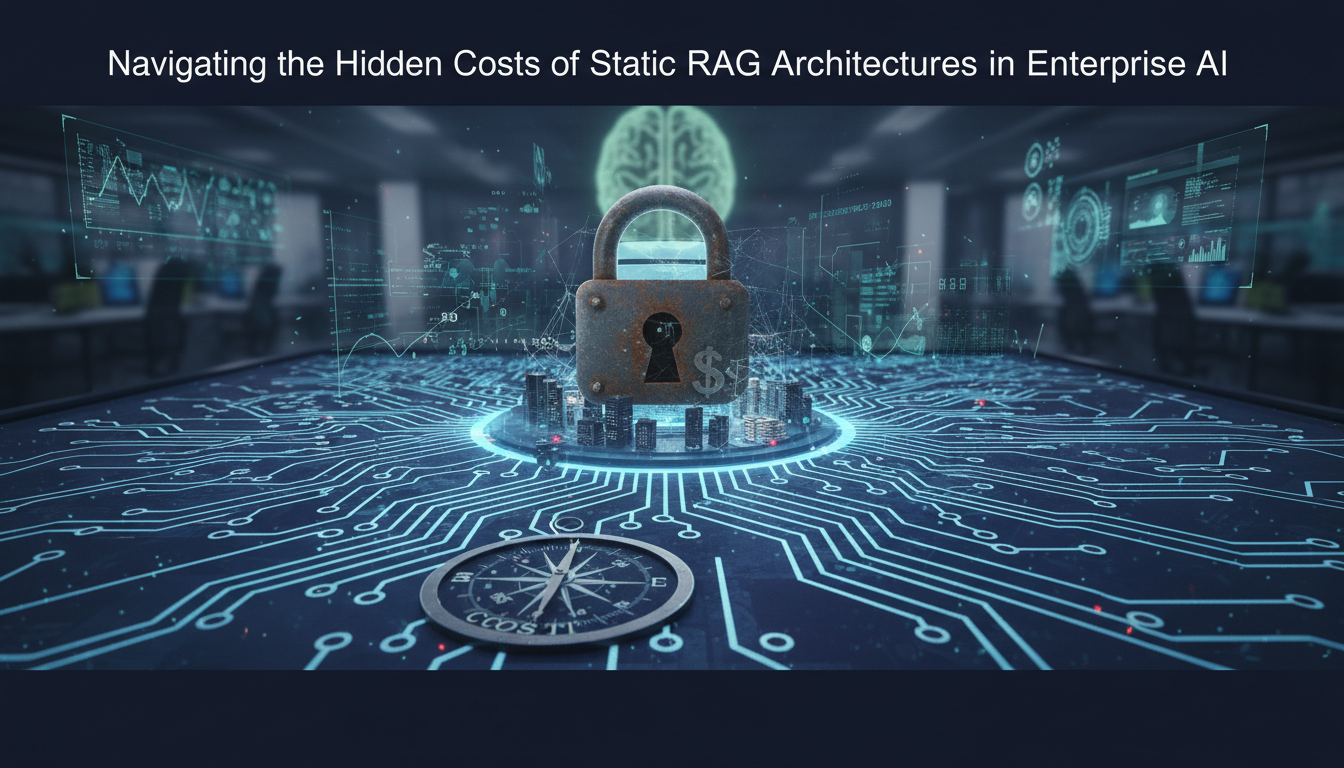
As enterprise AI continues to evolve, early 2026 witnesses a crucial realization: the very RAG (Retrieval-Augmented Generation) architectures bringing unprecedented accuracy are also draining budgets through inefficient API routing. While the technical teams bask in the glory of reduced hallucination rates and enhanced retrieval precision, financial departments raise alarms over AI infrastructure costs soaring by 15% year-over-year. Surprisingly, the models themselves are not to blame.
The Hidden Economics of Static RAG Routing
Most enterprise RAG systems employ a static approach to API configurations, hardcoding connections to specific LLM providers like GPT-4, Claude, or Gemini at deployment. This rigid methodology introduces several cost inefficiencies, transforming RAG from a cost-effective solution to a financial burden, especially as enterprises scale from pilot projects to production workloads.
API pricing is not static. It fluctuates with demand, new model releases, and competitive pressures. A static RAG system locked to a specific provider may end up overpaying significantly as prices change. For instance, a system set to GPT-4 could incur costs 40% higher than a model like Claude 3.5 Sonnet available at a better rate in the same year.
RAG queries often involve extensive context, pushing token counts into thousands per request. With high token costs, such as $0.03 per 1K tokens for GPT-4, a system processing 100,000 queries daily could burn through $18,000 monthly. If a portion of these queries could be routed to a cheaper model without sacrificing quality, significant savings could be realized.
Not all queries require the capabilities of frontier models. Simple tasks like factual retrieval or data extraction can perform equally well on mid-tier models, which are significantly cheaper. Static routing, however, treats all queries equally, leading to unnecessary expenditure on high-end models.
How API Aggregation Platforms Engineer Cost Intelligence
The emergence of API aggregation platforms offers a solution by incorporating an intelligent middleware layer between RAG systems and LLM providers. This approach allows enterprises to route requests dynamically, based on real-time decision logic, rather than pre-defined static routes.
Aggregation platforms analyze each RAG query across dimensions such as complexity, context length, and real-time pricing. This allows for:
These platforms aggregate consumption across multiple enterprises, enabling them to negotiate better rates with providers due to the high pooled volume. This results in significant cost advantages that are passed on to the enterprises, even for those with substantial token usage.
Intelligent routing platforms must balance cost savings with latency. By employing strategies like geographic routing and predictive pre-routing, they can minimize latency while optimizing costs, ensuring that user experience is not compromised.
The RAG Architecture Rethink: Implications for System Design
Adopting API aggregation transforms how enterprise RAG systems are architected, affecting observability, security, and failure modes.
Teams need to expand their focus beyond single-provider metrics to include routing decisions and cost attributions, enabling them to understand the financial impact of each routing policy.
With data flowing through multiple tiers, security becomes paramount. Ensuring data residency compliance, encryption, and audit logging is essential to protect sensitive information and meet regulatory requirements.
While aggregation distributes risks, it introduces new failure modes. Enterprises need robust fallback strategies to handle routing logic failures and ensure continuity.
Enterprise Adoption Realities: Integration Complexity and Vendor Risk
Despite clear benefits, adopting API aggregation poses integration challenges, especially for legacy systems deeply embedded with provider-specific logic. The risk of new vendor lock-in also looms, as enterprises become dependent on aggregation platforms.
The Path Forward: Architectural Principles for Cost-Intelligent RAG
The API aggregation trend underscores the need for cost-optimization-centric RAG designs from inception. Key principles include provider abstraction, real-time cost tracking, and maintaining multi-provider strategies to ensure flexibility and negotiation leverage.
Conclusion: The Cost Optimization Imperative
The promise of 80% cost reductions through API aggregation is not just marketing rhetoric; it's a necessary evolution for enterprises committed to sustainable AI deployment. As AI infrastructure costs attract increasing scrutiny, adopting intelligent routing through aggregation platforms will become a fiscal necessity. Enterprises must evaluate their current cost structures and initiate aggregation platform evaluations to remain competitive and financially viable.