
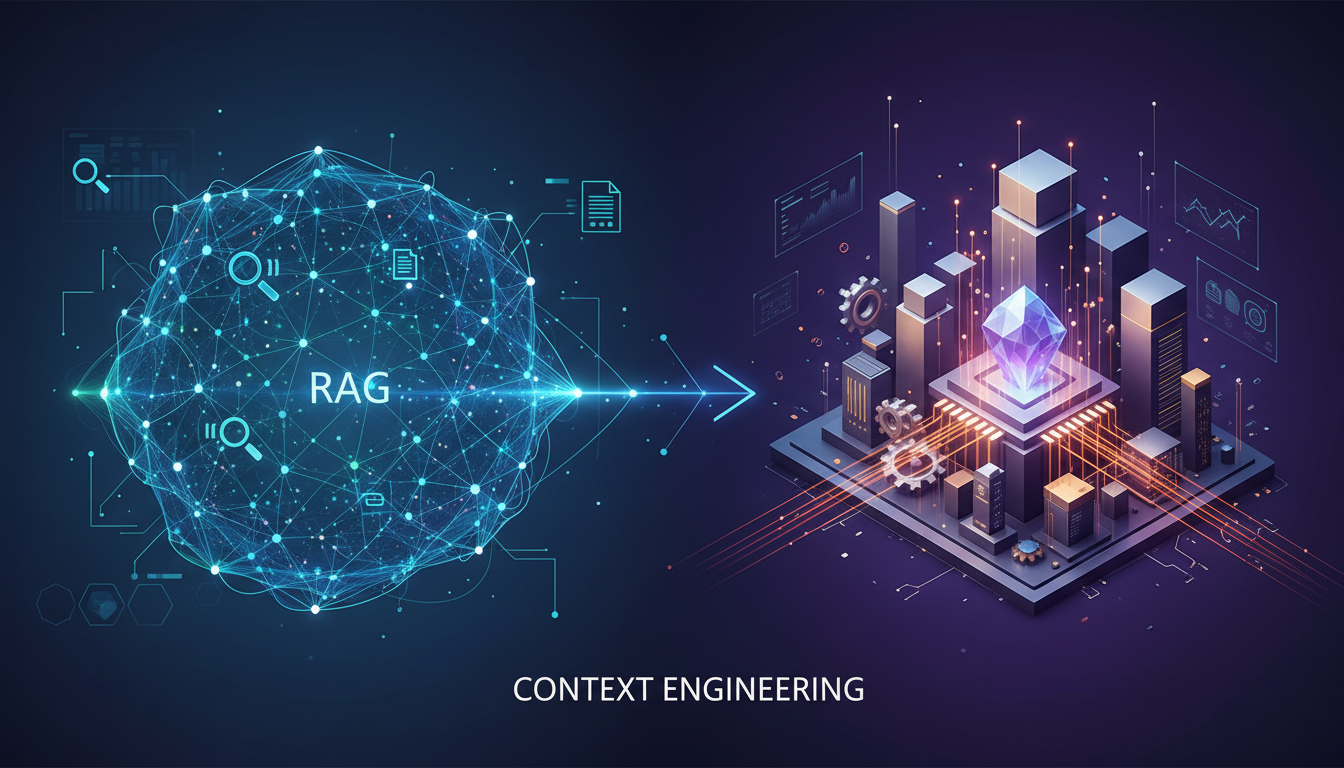
The landscape of enterprise AI is undergoing a significant transformation. For the past few years, Retrieval Augmented Generation (RAG) has been the primary approach for enabling AI systems to access proprietary enterprise data. This method involves embedding documents, constructing a vector database, retrieving the most relevant data chunks, and feeding them into a language model. While effective to a certain extent, a new paradigm is emerging that positions RAG as more of a stepping stone than a final solution: context engineering.
The Transition from RAG to Context Engineering
The concept of context engineering is gaining traction, with predictions that it will become a fundamental architectural layer in enterprise AI by 2026. Unlike RAG, which treats information retrieval as a simple lookup task, context engineering approaches it as a reasoning problem. This shift involves dynamically constructing the context required to generate the best possible response to a query, rather than merely retrieving semantically similar documents.
The difference between the two approaches is subtle but significant. In a traditional RAG system, the focus is on retrieving information based on semantic similarity. A context-engineered system, however, might execute sub-queries, consult knowledge graphs, pull live data from APIs, or synthesize information from multiple sources simultaneously. The retrieval step is just one part of a larger orchestration, rather than the entire solution.
The Instructed Retriever Innovation
One of the most notable developments in this shift is the Instructed Retriever. Companies like Databricks have highlighted its superiority over traditional RAG for enterprise applications. The Instructed Retriever replaces the passive retrieval component with an active one that follows instructions about what to retrieve, how to retrieve it, and how to synthesize the results.
In practice, this means that when a user queries the system with a complex question, the system doesn't just search for similar vectors and return top-k chunks. Instead, it breaks down the query, consults multiple data sources, and applies domain-specific reasoning to determine which information is truly relevant. This approach is particularly beneficial for complex enterprise queries that involve multiple data dimensions.
Agentic RAG and Multi-Agent Orchestration
Another dimension of this shift is the rise of agentic RAG, which moves beyond single-step retrieval into multi-step reasoning and action. This concept involves systems that can decide to retrieve information, evaluate its sufficiency, identify gaps, pull additional context, and synthesize findings. The system can loop, branch, and adapt its strategy based on the intermediate results it encounters.
Agentic RAG significantly benefits enterprise use cases. For example, a compliance query that once required extensive manual analysis can now be handled by an agentic system that dynamically retrieves relevant documents, applies jurisdiction-specific rules, and generates an assessment in real time. This capability offers substantial cost savings and efficiency improvements.
The Cost of Enterprise AI Systems
The financial implications of this evolution are considerable. The enterprise AI sector is projected to see spending grow from $37 billion in 2025 to $297 billion by 2027. However, many existing enterprise RAG systems are not delivering the expected value. Industry estimates indicate that around 80% of these projects fail to reach production or underperform due to inadequate architectures, poor data quality, and insufficient retrieval relevance.
Context engineering addresses many of these challenges by treating retrieval as an engineering challenge that goes beyond simple embedding problems. It emphasizes the importance of rich metadata, knowledge graph construction, and evaluation frameworks that assess retrieval utility rather than mere accuracy.
Preparing for the Context Engineering Era
For enterprises currently relying on RAG systems, the move to context engineering presents both challenges and opportunities. The transition requires a reevaluation of existing infrastructure and the adoption of new architectural principles. Here are some key considerations:
The transition to context engineering is not a disruption but an evolution of AI architecture. Companies that adapt early will be well-positioned to capitalize on the substantial enterprise AI spending wave, while those that stick with outdated RAG systems may find themselves constrained by their limitations.
In conclusion, the shift towards context engineering is reshaping how enterprises access and utilize their data. As we approach 2026, the "year of context," enterprise AI leaders must decide whether to lead this transition or risk falling behind. The time to evaluate and invest in context-engineered systems is now.