
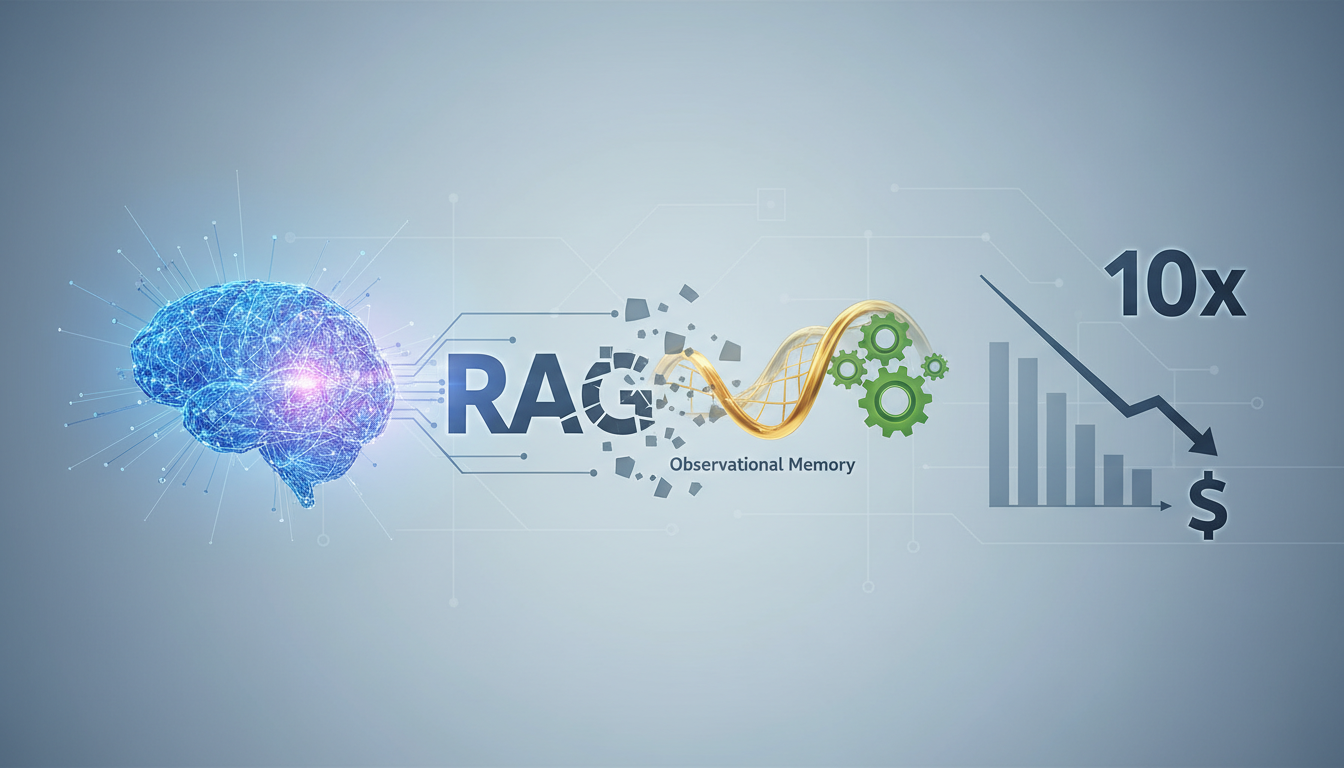
As enterprises continue to integrate AI into their operations, the relentless pursuit of efficiency and cost reduction remains paramount. The emergence of Observational Memory is challenging the conventional Retrieval-Augmented Generation (RAG) systems, promising a seismic shift in how enterprises deploy AI agents. This new approach offers the tantalizing prospect of slashing token costs by 10x and eliminating the reliance on vector databases.
The Underlying Costs of Traditional RAG Systems
RAG systems have long been the backbone of AI deployment, with their architecture built around storing knowledge in vector databases and retrieving relevant information on demand. While this approach appears logical, it comes with hidden costs that can escalate quickly:
Every query initiated in a RAG system triggers a retrieval operation, consuming significant compute resources. As the volume of queries increases, especially in an enterprise setting, the costs associated with these operations become substantial.
Balancing the breadth of information retrieval with the limitations of a language model's context window is an ongoing challenge. The constant need to refine and optimize this balance demands continuous investment in system tuning.
Maintaining vector databases involves a labyrinth of indexing, tuning, and monitoring. As the scale of the knowledge base grows, so does the complexity and cost of maintenance.
The Observational Memory Advantage
Observational Memory introduces a paradigm shift by fundamentally rethinking how AI systems handle memory. Instead of retrieving stored data, it employs two background agents—Observer and Reflector—to create a dynamic and compressed representation of interactions.
The Observer Agent : Functions in real-time to extract key insights from ongoing conversations. Instead of storing raw transcripts, it records structured interpretations, effectively summarizing dialogue into actionable insights.
The Reflector Agent : Periodically reviews the compiled observations to identify patterns and prioritize information based on relevance and recency. This consolidation process ensures that valuable information remains accessible without unbounded memory growth.
By leveraging these agents, Observational Memory maintains context windows of up to 30,000 tokens, eliminating the need for external vector storage and, more importantly, reducing token usage by a staggering 10x compared to traditional RAG methods.
The Compression Paradox: Less Data, Better Performance
One of the most compelling aspects of Observational Memory is its ability to improve decision quality by reducing stored data. Traditional RAG systems often suffer from "retrieval noise," where marginally relevant documents dilute the signal with noise. Observational Memory, by contrast, filters out noise at the point of data ingestion, maintaining a high signal-to-noise ratio.
Benchmark data underscores this advantage, revealing that Observational Memory systems not only maintain coherence and accuracy over extended interactions but also achieve significant compression ratios of 3-6x for text interactions and 5-40x for tool-heavy workflows.
When Observational Memory Fits Best
While Observational Memory offers substantial benefits, it is not a universal solution. It excels in scenarios where long-term context retention and decision continuity are critical, such as:
However, it might not be suitable for environments that require real-time knowledge updates or strict compliance with data retention regulations.
The Security Considerations
Adopting Observational Memory necessitates a reevaluation of security strategies. The dense log architecture, while efficient, introduces unique vulnerabilities. Enterprises must address GDPR compliance complexities and heightened risks from persistent prompt injection attacks.
Strategic Considerations for Enterprise Teams
For enterprises contemplating a shift to Observational Memory, a strategic approach is essential:
Conclusion
Observational Memory represents a fundamental shift in AI architecture, challenging the dominance of traditional RAG systems with its promise of efficiency and cost reduction. While it won't replace RAG in every scenario, its strategic deployment can offer significant advantages in appropriate contexts. Enterprise teams must assess their unique requirements and constraints to determine whether Observational Memory's benefits align with their operational goals. As the AI landscape continues to evolve, staying adaptable and open to architectural innovation will be key to maintaining a competitive edge.