
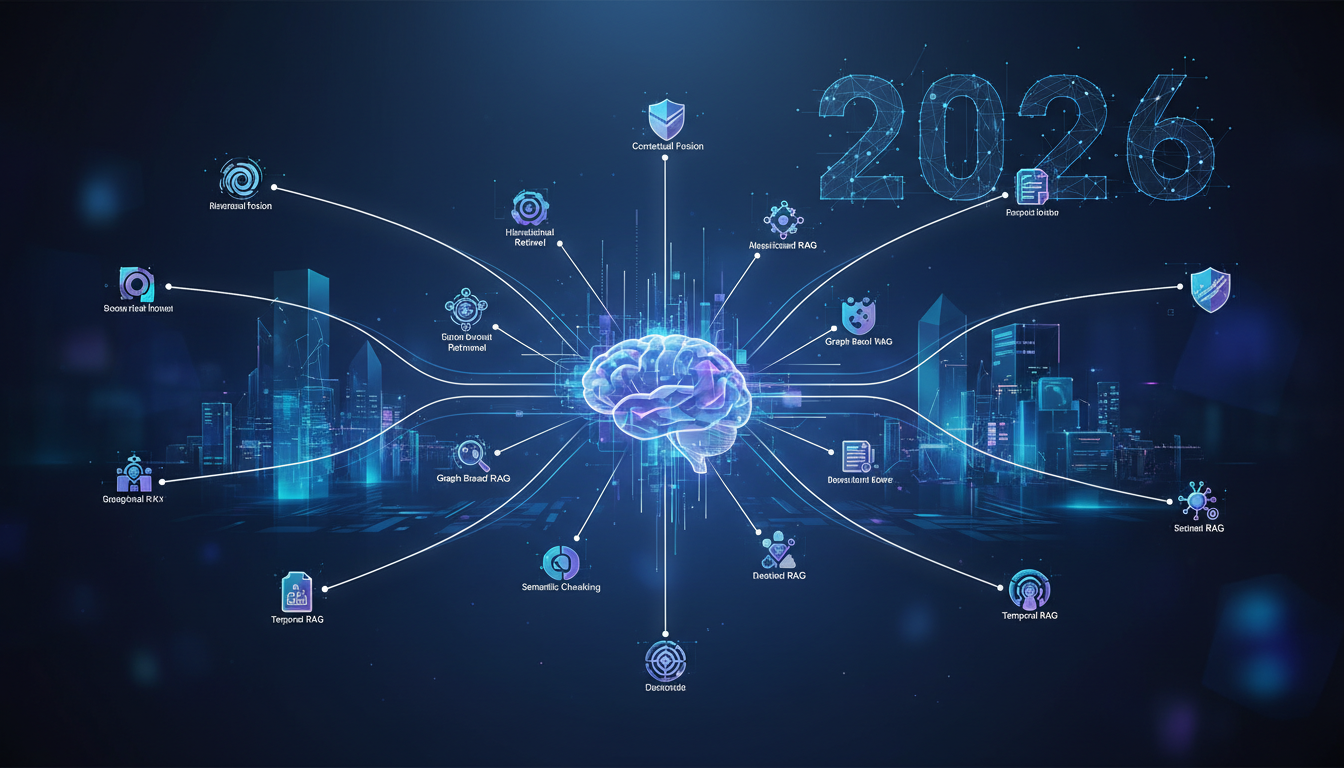
Revolutionizing Enterprise AI: Top 15 Advanced RAG Techniques for 2026 Introduction As we move into 2026, enterprises are increasingly focusing on refining AI systems to ensure reliability and trustworthiness. With the remarkable capabilities of large language models (LLMs), the emphasis has shifted from mere capability to precision in retrieval, contextual accuracy, and robust governance. Advance
Introduction
As we move into 2026, enterprises are increasingly focusing on refining AI systems to ensure reliability and trustworthiness. With the remarkable capabilities of large language models (LLMs), the emphasis has shifted from mere capability to precision in retrieval, contextual accuracy, and robust governance. Advanced Retrieval-Augmented Generation (RAG) techniques are at the forefront, transforming enterprise AI from a risky experiment into a dependable strategic asset.
Why Advanced RAG Techniques Matter for Enterprise AI
In today's landscape, the success of generative AI within enterprises hinges on retrieval intelligence rather than model size. A significant hurdle to scaling AI in production is the phenomenon of hallucinations and unreliable outputs. These arise because LLMs generate probabilities, not verified facts, making retrieval precision crucial.
The Evolution of Retrieval-Augmented Generation Architecture
The journey of RAG architecture evolution can be categorized into five phases:
This foundational phase relies on basic embedding searches but suffers from poor relevance precision, making it unsuitable for large enterprises.
Incorporating sparse and dense retrieval with metadata filtering, this phase improves lexical and semantic balance, although context memory remains limited.
By integrating knowledge graphs and optimizing context windows, this phase reduces ambiguity and hallucination, offering high enterprise readiness.
This involves multi-step retrieval and dynamic context expansion, facilitating complex reasoning. It demands a sophisticated orchestration layer but provides very high enterprise readiness.
Featuring observability dashboards and retrieval evaluation metrics, this phase ensures production-scale reliability through high maturity and enterprise-grade readiness.
Deep Dive: 15 Advanced RAG Techniques
DPR uses dual-encoder models to capture semantic meaning, transcending keyword dependency and enhancing support responses and QA systems.
This technique enhances precision by training models to differentiate between relevant and irrelevant document pairs, critical for legal and regulatory contexts.
Embedding conversation history into retrieval pipelines helps capture user intent, vital for conversational AI applications in customer service and beyond.
Cross-encoders refine document rankings, dramatically reducing hallucinations and improving response accuracy.
Integrating structured entity relationships improves disambiguation, compliance interpretation, and research workflows, especially in regulated industries.
This organizes vast document repositories by domain and topic, enhancing retrieval efficiency and contextual grounding for large enterprises.
DMNs enable the retention of reasoning steps, crucial for multi-step investigations and fraud analytics.
Prioritizing named entities in retrieval processes reduces ambiguity, vital for precision in enterprise environments dealing with contracts and policies.
Iterative refinement through prompt chaining significantly boosts factual grounding, essential for troubleshooting and investigative workflows.
This decomposes complex queries into sequential sub-queries, supporting strategic decision-making and policy analysis.
Combining sparse and dense retrieval methods ensures both lexical precision and semantic depth, a best practice in high-stakes domains.
Re-ranking layers between retrieval and generation improve contextual relevance, crucial for maintaining trust in AI systems.
This approach blends lexical scoring with neural weighting, enhancing precision while preserving interpretability, especially in industries like insurance and healthcare.
By enriching documents with query-relevant signals, this technique reduces missed retrieval opportunities, vital for ESG reporting and strategic forecasting.
Combining iterative retrieval with context expansion and memory augmentation, this technique transforms RAG into a reasoning engine, crucial for enterprise-grade AI.
Conclusion
Advanced RAG techniques are redefining enterprise AI architecture, emphasizing retrieval-centric approaches over model-centric ones. As organizations integrate these sophisticated methods, they transition RAG from an experimental feature to a trusted decision intelligence platform. Enterprises investing in these techniques today will be poised to build AI systems that are explainable, reliable, and scalable tomorrow.