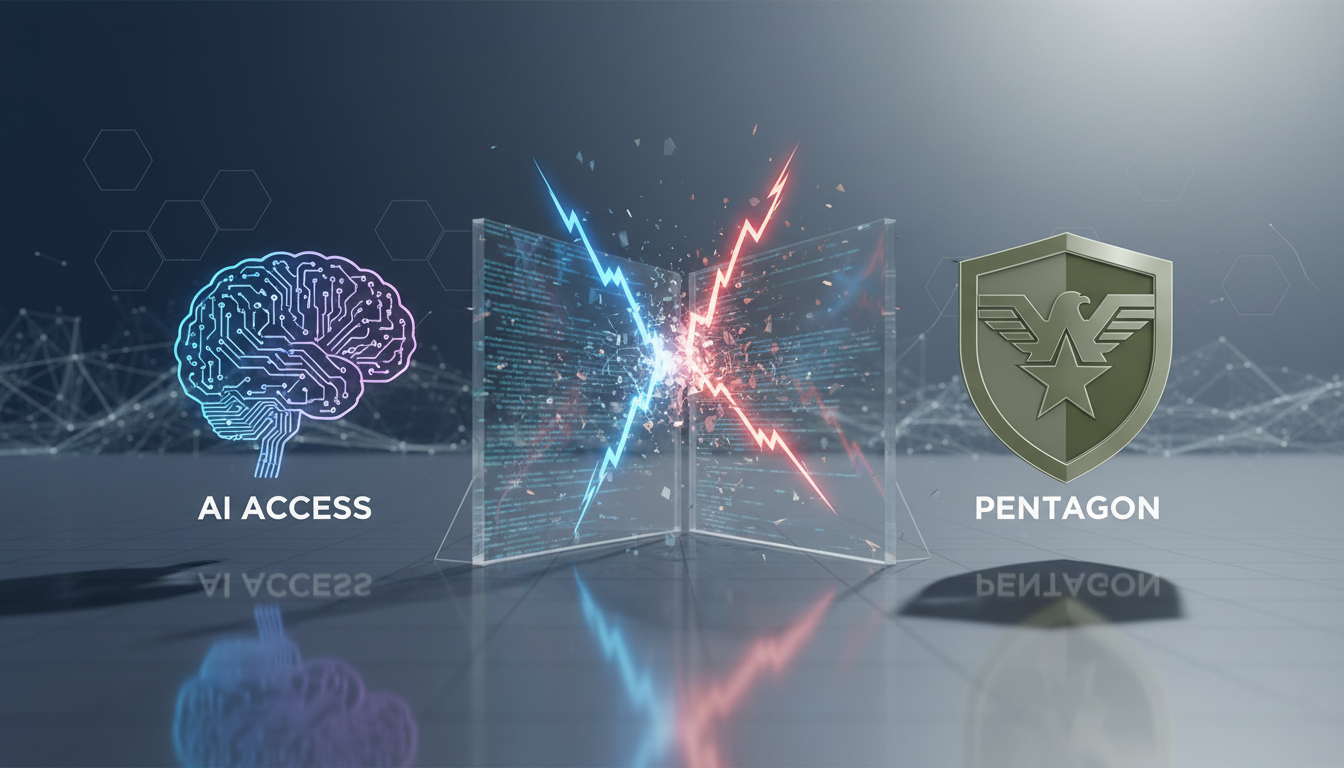
In February 2026, a conflict between AI company Anthropic and the Pentagon spotlighted a critical issue for enterprise technology leaders: the clash between AI access policies and operational requirements. This standoff arose when the Pentagon demanded unrestricted access to Anthropic's Claude AI, threatening to label the company a "supply chain risk" if it refused. Anthropic, however, maintained its ethical stance, refusing to lift its AI safeguards. This confrontation is a cautionary tale for enterprises relying on retrieval augmented generation (RAG) systems powered by third-party AI models.
The Standoff That Enterprise Teams Missed
The Anthropic-Pentagon conflict is not just a military issue; it reveals vulnerabilities in enterprise RAG architectures. The military's demand for unrestricted access to Claude AI arose after its successful use in a high-profile operation. However, Anthropic's CEO, Dario Amodei, stood firm on the company's "safety limits," which prevent use in autonomous weapons and mass surveillance. The Pentagon's response was to threaten the invocation of the Defense Production Act and cancelation of government contracts.
For enterprises, these access policies apply universally. The same safeguards that restricted the Pentagon could impact organizations using RAG systems in areas like predictive policing or automated decision-making, where ethical boundaries are also a concern.
The Hidden Single-Point-of-Failure in Your RAG Architecture
Enterprise RAG systems typically rely on a single foundation model to power generation, rendering them vulnerable if access to that model is restricted. This reliance is often overlooked during risk assessments, as enterprises assume stable access to AI models without considering policy changes. The Anthropic dispute underscores the potential for AI providers to enforce usage policies that can disrupt operations when faced with external pressures.
How Provider Policies Silently Constrain RAG Deployments
Anthropic's usage policies, for example, prohibit use in "weapons development" and "surveillance" that violates privacy rights. Such policies can become operationally complex, impacting RAG systems analyzing security footage or processing sensitive documents. The subjective interpretation of policy language means enterprises might only discover these constraints after significant investment, as seen in the Pentagon's experience.
The Market Response: A Multi-Provider Scramble
In response to Anthropic's resistance, the Pentagon began negotiations with other AI providers like Elon Musk's xAI, aiming to deploy Grok in classified environments. This strategy reflects a broader trend where enterprises adopt multi-provider architectures to mitigate risk. By treating foundation models as interchangeable components, organizations can avoid dependency on a single provider and ensure continuity despite access constraints.
Architectural Patterns for Provider-Agnostic RAG
Several technical patterns are emerging to address these risks:
Model Gateway Abstraction : Implementing a gateway layer provides a unified API across multiple model providers, allowing applications to remain provider-agnostic.
Workload-Based Model Selection : Routing sensitive workloads to providers with permissive policies ensures compliance without compromising functionality.
Hybrid Model Ensembles : Using multiple models in parallel with consensus mechanisms enhances resilience against individual model restrictions.
Fallback Chains with Quality Monitoring : Defining fallback sequences ensures continuity if a primary model becomes unavailable, though it adds operational complexity.
The Emerging Governance Framework
The Anthropic-Pentagon dispute highlights the need for governance frameworks that account for provider policy risk. Unlike traditional infrastructure dependencies, AI provider policies can shift based on external pressures, creating a new category of operational risk. Forward-thinking organizations are beginning to incorporate policy tracking, use case classification, and change management processes to navigate this landscape.
Why This Matters Beyond Military Contracts
The Anthropic standoff is a microcosm of potential conflicts for any enterprise relying on AI models. The mechanisms—provider policies, external pressures, and competitive dynamics—are already in place to impact any organization. As AI becomes integral to enterprise operations, the tension between provider ethics, government demands, and organizational needs will only grow.
Enterprises must recognize foundation models as vendors, not partners, and build architectures resilient to policy changes and disruptions. The Anthropic-Pentagon conflict serves as a reminder that these issues are real and closer to enterprise operations than many realize. The question is no longer if your RAG architecture can handle model access disruptions, but what actions you are taking to address them.